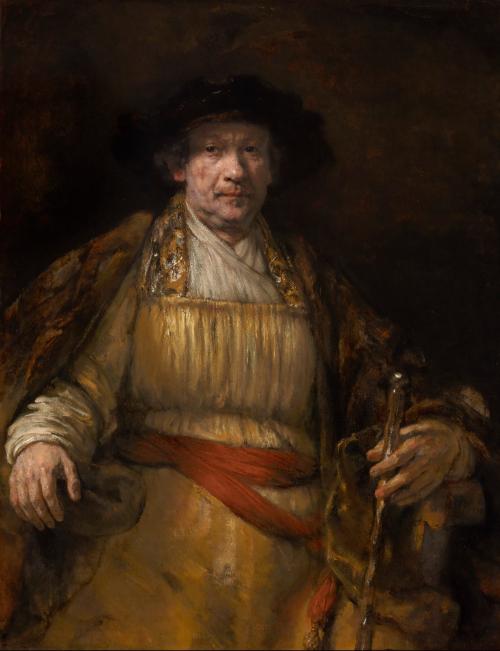
Of the many self-portraits Rembrandt painted, this is one of the most iconic, not only for its poignant revelations of the self but for its painterly magnificence.
The initial effect is daunting, as though we are confronting an ill-tempered monarch or a wealthy man displeased with our conduct. The clothes worn are timeless and exotic. In place of a crown, a large velvet beret floats over Rembrandt’s head like a shifting cloud. The painter holds a staff as though it were a scepter. Yet this feeling of an uneasy confrontation diminishes as one focuses on the features. A veil of what seems like wariness shadows the painter’s face, which is blurred and scarred—by time, sorrow, and illness. Rembrandt was only fifty-two when he signed and dated this portrait. He was also a short man, but he portrayed his figure in monumental dimensions. It is almost as though he decided to pack his entire life into this image of himself, both what had gone before and what lay ahead.
His gigantic hands before us remind us of Rembrandt’s profession as an artist. They are, after all, the physical instruments with which he created this grand illusion.
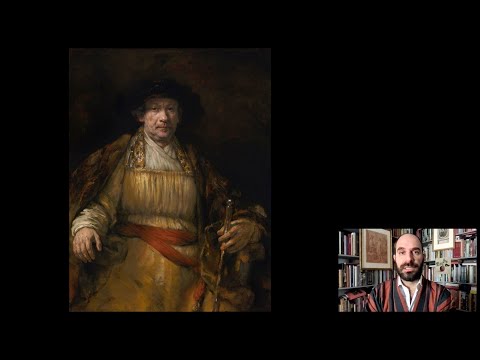
Self-Portrait
Rembrandt made dozens of self-portraits in paint and in print over the course of his career. Signed and dated in the lower right corner, this is the largest and most iconic of the portraits. It was produced when he was fifty-two and had recently declared bankruptcy despite having achieved enormous prominence and success as an artist in Amsterdam. Still, in this canvas he presents himself larger than life-size and as if enthroned, wearing gold-colored clothing and draped with a mantle, confronting the viewer frontally and holding a staff like a scepter. A black velvet beret casts a shadow on his face, from which his dark eyes emerge. Thick impasto paint creates the texture of his aged skin, both on his face and on his large hands, emphasizing the manual skill of his craft. This majestic depiction may have been created for sale to one of his previous collectors.
Source: The Frick Collection: Essential Guide, 2024
Earls of Ilchester. Knoedler. Frick, 1906.
Source: Paintings in The Frick Collection: American, British, Dutch, Flemish and German. Volume I. New York: The Frick Collection, 1968.