#170: By Giulio Dalvit, Associate Curator Transcript
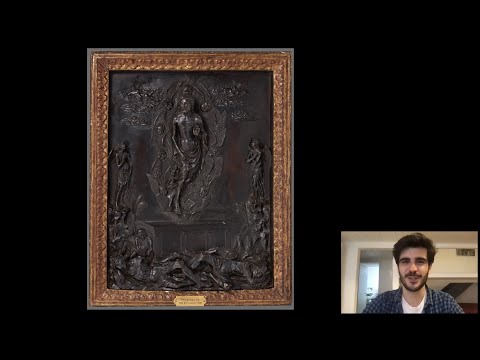
This Resurrection is one of the finest bronze reliefs from fifteenth­century Italy. It is also the only fully authenticated small bronze by Vecchietta and the only work securely attributed to the artist in the United States. Here, this sophisticated Sienese artist represents the Risen Christ floating in a mandorla of angel-heads over his open sepulcher. He is flanked by two adoring angels standing on rocks, while many others rejoice in the clouds behind him. Below him, the soldiers guarding the sepulcher are fast asleep, sprawled on the ground. The inscription on the sepulcher, below the figure of Christ, reads, in Latin: “The work of the painter Lorenzo di Pietro, known as Il Vecchietta, from Siena in the year 1472.” Vecchietta had an intriguing habit of signing his paintings as a sculptor and his sculptures as a painter, which signals the lack of the word “artist” for fifteenth-century craftsmen who were working across media. The original function of this relief is unclear, but it was displayed in a gallery, like a painting, when it belonged to the seventeenth-century Roman cardinal Flavio Chigi, who also owned Titian’s portrait of Pietro Aretino, also at the Frick.

The Resurrection

 (Italian, 1410–1480)
Date1472
MediumBronze
Dimensions21 3/8 x 16 1/4 in. (54.3 x 41.3 cm)
Credit LineHenry Clay Frick Bequest
Accession number1916.2.02
Commentary

The only signed work by Vecchietta held outside of Italy, this relief represents the Risen Christ floating in a mandorla of angel heads over his open sepulcher. He is flanked by two adoring angels standing on rocks, while others rejoice in the clouds behind him. Below him, the soldiers guarding the sepulcher are fast asleep, sprawled on the ground. The Latin inscription on the sepulcher reads, "the work of the painter Lorenzo di Pietro, known as Il Vecchietta, from Siena in the year 1472." The sophisticated Sienese artist had the habit of signing his paintings as a sculptor and his sculptures as a painter, thus pointing to the complex relationship between strands of his production before the modern concept of "art" came to straddle them. This relief was defined as a "head-sized picture" when it was displayed in the gallery of the seventeenth-century Roman cardinal Flavio Chigi, who also owned Titian's portrait of Pietro Aretino.

Source: The Frick Collection: Essential Guide, 2024 

Collection History

Prince Chigi, Rome. Rodolphe Kann, Paris. J. Pierpont Morgan, London and New York. Duveen. Frick, 1916.

Source: Sculpture in The Frick Collection: Italian. Volume III. New York: The Frick Collection, 1970.
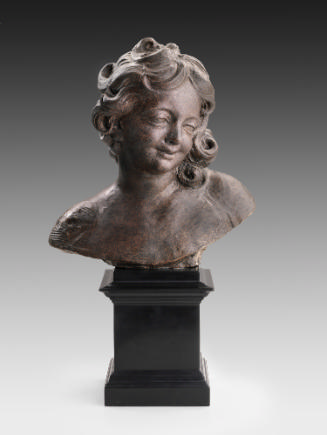
Terracotta sculpture of a head of an angel.  The angel has curly hair, which gathers by the lef…
Attributed to Gian Lorenzo Bernini
ca. 1655
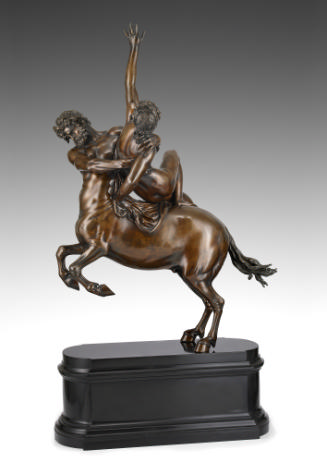
Bronze sculpture of a woman struggling against a centaur
Attributed to Pietro Tacca
late 16th to early 17th century
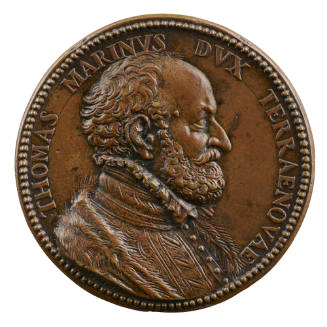
Bronze portrait medal of Tommaso Marino wearing a high-collared doublet buttoned up the front w…
Romano (Pietro Paolo Galeotti)
ca. 1560–65
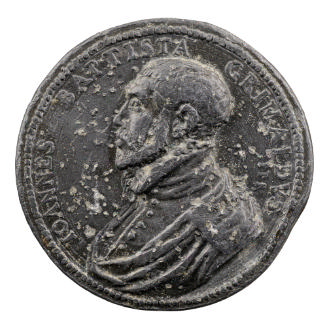
Lead portrait medal of Giambattista Grimaldi wearing a high-collared doublet buttoned up the fr…
Romano (Pietro Paolo Galeotti)
ca. 1565
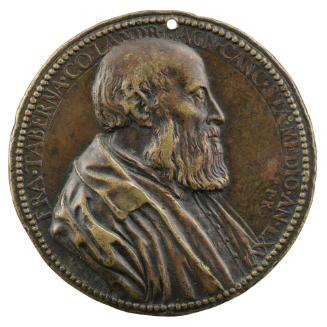
Bronze portrait medal of Francesco Taverna, bearded, in profile to the right; pearled border
Romano (Pietro Paolo Galeotti)
dated 1554
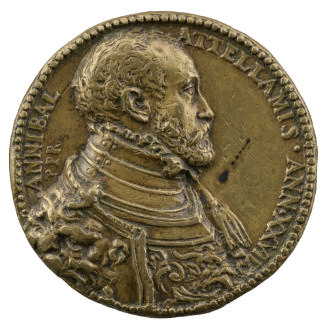
Bronze portrait medal of Annibale Attellami bearded, wearing richly decorated armor and a ruff,…
Romano (Pietro Paolo Galeotti)
ca. 1570
Bronze portrait medal of Girolamo Figino with curly hair and beard, in profile to the left; pea…
Loan
Romano (Pietro Paolo Galeotti)
dated 1562
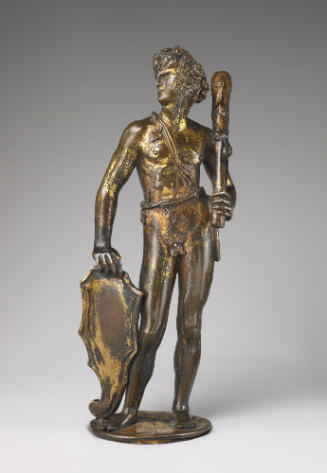
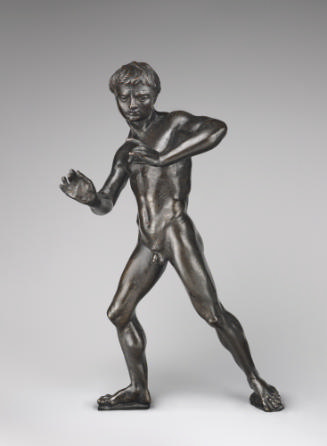
Bronze sculpture of a man standing upright.  His head is turned to his right and he is holding …
Bertoldo di Giovanni
ca. 1470–80
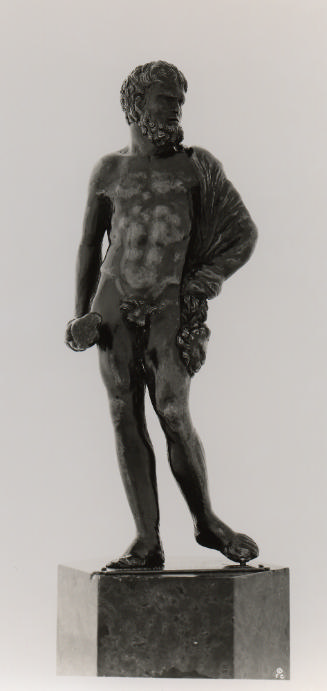
A bronze sculpture of Hercules.  His head is turned to his left.  He has a lion's pelt draped o…
Attributed to a follower of Bertoldo di Giovanni
15th century
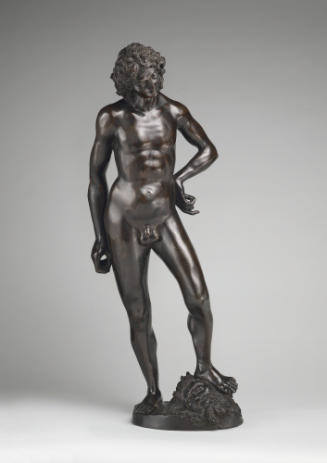
A bronze sculpture of David. He is looking down, his left hand is on his left hip and his left …
Attributed to Giovanni di maestro Stefano
late 15th century to early 16th century
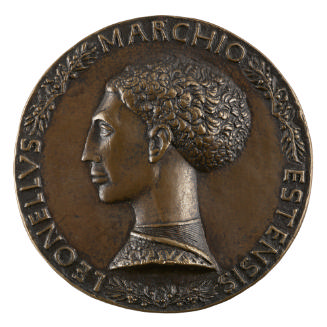
Bronze portrait medal of Leonello d'Este in profile to the left
Pisanello (Antonio di Puccio Pisano)
ca. 1445
Bronze sculpture of a satyr with two hands up as if holding a flute that's no longer there
After Maso di Bartolomeo
second half of the 15th century
Copyright © 1998-2026 The Frick Collection. All Rights Reserved.
InstagramFacebookXYoutubeThreadsmenusearch2