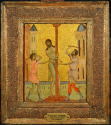
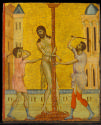
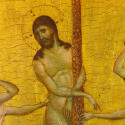
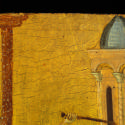
Representing an episode of the passion of Christ, this small panel depicts Roman guards flagellating Jesus with whips before sending him to his death. The thirteenth-century artist Cimabue, thought to have been Giotto’s master, envisioned a devotional painting intended to bring the viewer closer to Christ’s suffering. The structures in the background frame the center of the composition where the torture is taking place.
Although building on the tradition of Byzantine icons, Cimabue played a key role in the history of western art by investigating the possibilities of perspective and motion. With tiny, layered brushstrokes, Cimabue renders Christ and his tormentors in minute detail.
When Henry Clay Frick’s daughter Helen purchased this painting, in 1950, its authorship was debated. Fifty years later, the discovery of another Cimabue panel depicting the Virgin and Child, now at the National Gallery in London, dispelled any lingering doubts as to the author of the Frick panel. Technical examination has shown it to be part, with the Virgin and Child, of a larger complex by Cimabue that was probably made out of eight scenes and mounted as a diptych. In 2019, a third panel—The Mocking of Christ—was discovered in the kitchen of an elderly French woman. With so little of Cimabue’s work surviving, the new attribution is a major discovery that puts the artist’s remarkable talents into finer focus.
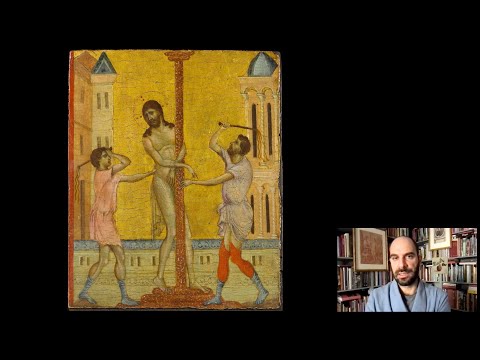
The Flagellation of Christ
This is the earliest painting in the Frick's collection. Although little of this Florentine artist's work survives, his impact on later generations was significant. He is thought to have been the master of Giotto, among the most prolific and prominent of early Renaissance painters. Cimabue's painting style builds on the tradition of Byzantine icons while exploring new possibilities of perspective and motion. Here, depicting an episode from the Passion—or sufferings—of Christ, Cimabue presents Roman guards flagellating Christ with whips before sending him to his death. The composition brings the viewer close to Christ's suffering; tiny, layered brushstrokes render him and his tormentors in minute detail. The structures in the background frame the central action. Technical examination shows that the Frick panel was part of a larger complex—probably made up of eight scenes and mounted as a diptych--including The Virgin and Child Enthroned with Two Angels now at the National Gallery in London. A third related panel, The Mocking of Christ, was recently discovered in France and is now at the Musée du Louvre in Paris.
Source: The Frick Collection: Essential Guide, 2024
Acquired at the end of the 19th century by M. Rolla; passed on to G. Rolla before being sold. E. Moratilla, Paris. Knoedler. Frick, 1950.
Source: Paintings in The Frick Collection: French, Italian and Spanish. Volume II. New York: The Frick Collection, 1968.